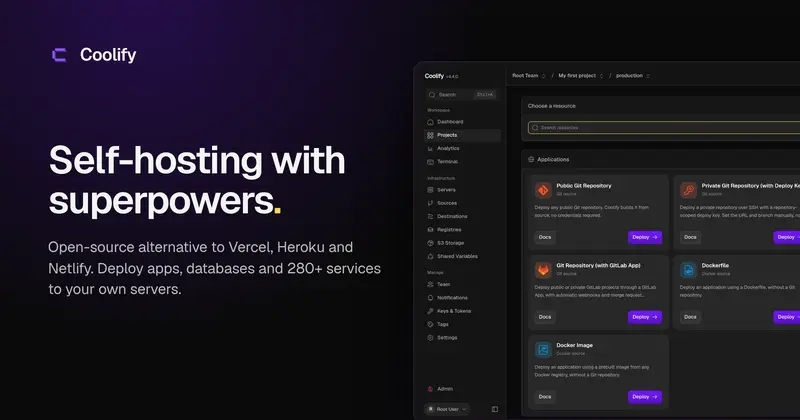
Coolify is a platform that lets you deploy apps, databases and services on your own servers, managed through a web dashboard. It is for people who want the convenience of a cloud hosting service while keeping control of their own infrastructure.
Dokku is a self-hosted tool that lets developers deploy web apps to their own server, similar to Heroku, using Docker. It is aimed at programmers and sysadmins who want to run their own app hosting.
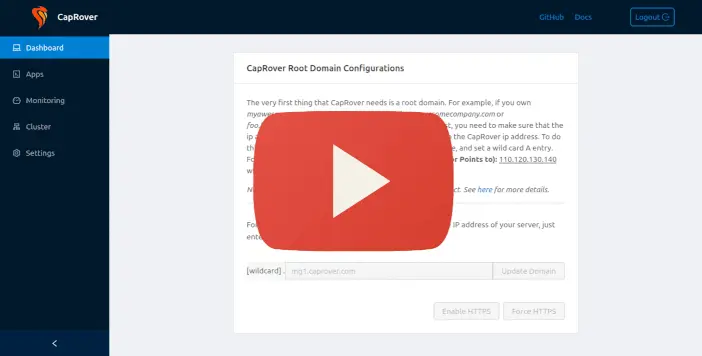
CapRover is a program you install on your own server to publish web apps and databases without writing server setup by hand. It is aimed at developers who want to host their own projects and cut hosting costs.
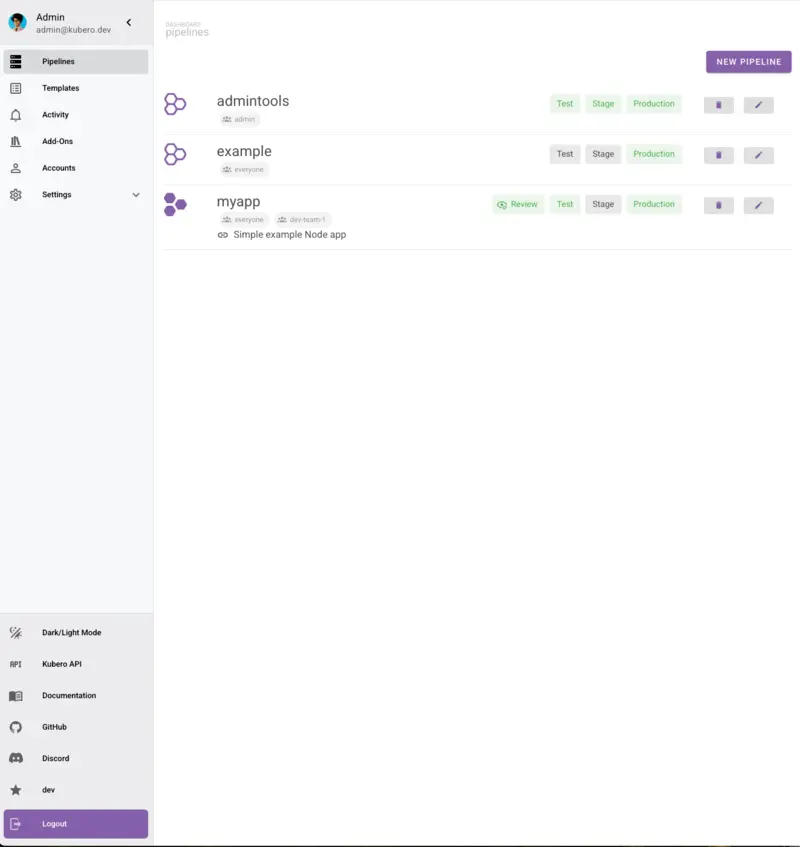
Kubero is a free tool that lets people put their web apps online on their own Kubernetes cluster, using a web interface instead of writing configuration by hand. It is for developers who want a Heroku-style way to deploy apps without running the platform on someone else's servers.
Otomi, now called App Platform and maintained by Akamai, is a self-hosted platform that runs on a Kubernetes cluster and lets teams build apps from source code, deploy them and put them online. It is for developer teams and platform administrators who run their own Kubernetes infrastructure.
Peon is a self-hosted platform for deploying web apps, Docker stacks, databases and static sites from Git to servers you control. It is for developers and small teams who want a Heroku-style service on their own infrastructure.
Nua is a self-hosted platform for building, deploying and managing web applications on your own server from the command line. It is aimed at small businesses, associations and public services, and is still early-stage software not yet meant for production.
Hop3 is an open-source platform for deploying and running web apps on your own servers, including apps from a ready-made catalog. It is aimed at small businesses, non-profits and individual developers, but is still in early development and not yet recommended for unattended production use.
1.8kActiveIn your browserApache-2.0Replaces partlyFor developers
dyrector.io is a self-hosted platform that helps teams deliver and deploy their containerized applications, with version management built in. It is aimed at engineers, DevOps teams and individual developers who want to spend less time setting up their container infrastructure.
For developers · GitHub
None of these match. Try another device.
Before you build
Planning something for an alternative to Render? See what exists first, so you can reuse parts or explain what's different. Paste this into any AI assistant:
Read the list of open-source alternatives at https://opensourceeverything.org/data/groups/app-hosting.json. Compare it with my project or idea below. Tell me which projects overlap, what I could reuse instead of rewriting, and what mine does that none of them do.
My project or idea:
Here is a list of open-source alternatives to Render, from Open Source Everything (CC BY-SA 4.0):
- Coolify (Apache-2.0, https://github.com/coollabsio/coolify; replaces fully): Coolify is a platform that lets you deploy apps, databases and services on your own servers, managed through a web dashboard. It is for people who want the convenience of a cloud hosting service while keeping control of their own infrastructure.
- Dokku (MIT, https://github.com/dokku/dokku; replaces fully): Dokku is a self-hosted tool that lets developers deploy web apps to their own server, similar to Heroku, using Docker. It is aimed at programmers and sysadmins who want to run their own app hosting.
- CapRover (Apache-2.0, https://github.com/caprover/caprover; replaces fully): CapRover is a program you install on your own server to publish web apps and databases without writing server setup by hand. It is aimed at developers who want to host their own projects and cut hosting costs.
- Kubero (GPL-3.0, https://github.com/kubero-dev/kubero; replaces fully): Kubero is a free tool that lets people put their web apps online on their own Kubernetes cluster, using a web interface instead of writing configuration by hand. It is for developers who want a Heroku-style way to deploy apps without running the platform on someone else's servers.
- Otomi (Apache-2.0, https://github.com/linode/apl-core; replaces fully): Otomi, now called App Platform and maintained by Akamai, is a self-hosted platform that runs on a Kubernetes cluster and lets teams build apps from source code, deploy them and put them online. It is for developer teams and platform administrators who run their own Kubernetes infrastructure.
- Peon (MIT, https://github.com/Peon-sh/Peon; replaces fully): Peon is a self-hosted platform for deploying web apps, Docker stacks, databases and static sites from Git to servers you control. It is for developers and small teams who want a Heroku-style service on their own infrastructure.
- Abilian Nua (AGPL-3.0, https://github.com/abilian/nua; replaces fully): Nua is a self-hosted platform for building, deploying and managing web applications on your own server from the command line. It is aimed at small businesses, associations and public services, and is still early-stage software not yet meant for production.
- Abilian Hop3 (Apache-2.0, https://github.com/abilian/hop3; replaces fully): Hop3 is an open-source platform for deploying and running web apps on your own servers, including apps from a ready-made catalog. It is aimed at small businesses, non-profits and individual developers, but is still in early development and not yet recommended for unattended production use.
- dyrector.io (Apache-2.0, https://github.com/dyrector-io/dyrectorio; replaces partly): dyrector.io is a self-hosted platform that helps teams deliver and deploy their containerized applications, with version management built in. It is aimed at engineers, DevOps teams and individual developers who want to spend less time setting up their container infrastructure.
Compare it with my project or idea below. Tell me which projects overlap, what I could reuse instead of rewriting, and what mine does that none of them do.
My project or idea: