SurfSense is a free desktop app that lets you ask an AI questions about your own documents, with the files and index staying on your computer. It is for people who want a NotebookLM-style assistant that works on private files and can run without an internet connection.
Has 3 of 6 · Ready-made connections ✗ +1
How many people bookmarked its code on GitHub. It shows how popular it is, not how good it is or how well it replaces the app.
How hard it is to start using it. Easy: install it like a normal app, or use it in your browser. Advanced: you run it on your own server, use the command line, or it is a tool for developers.
Its code changed within the last year, so someone is still looking after it.
Does the whole job.
Ordered by how fully it replaces the app, Verified, setup and, when there are enough, people's votes.
Windows · Mac · Linux · Android · iPhone · In your browserAGPL-3.0
Khoj is a personal AI assistant that answers questions using your own files, notes and the internet, and can be run on your own computer or server. It is aimed at people who want an AI helper that works with their own documents and knows their information.
Has 2 of 6
How many people bookmarked its code on GitHub. It shows how popular it is, not how good it is or how well it replaces the app.
How hard it is to start using it. Easy: install it like a normal app, or use it in your browser. Advanced: you run it on your own server, use the command line, or it is a tool for developers.
Its code changed within the last year, so someone is still looking after it.
Does the whole job.
Ordered by how fully it replaces the app, Verified, setup and, when there are enough, people's votes.
AnythingLLM is an app that lets you chat with an AI assistant about your own documents, and can run models locally or connect to cloud AI services. It is aimed at people and teams who want a private, self-hosted or desktop alternative to ChatGPT-style chat tools.
Has 2 of 6 · Ready-made connections ✗
How many people bookmarked its code on GitHub. It shows how popular it is, not how good it is or how well it replaces the app.
How hard it is to start using it. Easy: install it like a normal app, or use it in your browser. Advanced: you run it on your own server, use the command line, or it is a tool for developers.
Its code changed within the last year, so someone is still looking after it.
Does the whole job.
Ordered by how fully it replaces the app, Verified, setup and, when there are enough, people's votes.
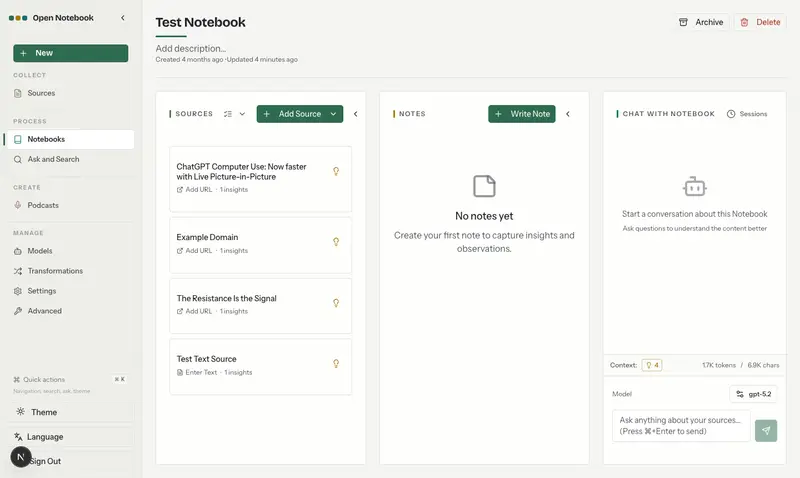
Open Notebook is a free, self-hosted notebook where you keep your own research files and notes and can ask an AI questions about them. It is for people who want an alternative to Google's NotebookLM and want to keep their data on their own machine or server.
Has 2 of 6 · No server needed ✗ +1
How many people bookmarked its code on GitHub. It shows how popular it is, not how good it is or how well it replaces the app.
How hard it is to start using it. Easy: install it like a normal app, or use it in your browser. Advanced: you run it on your own server, use the command line, or it is a tool for developers.
Its code changed within the last year, so someone is still looking after it.
Does the whole job.
Ordered by how fully it replaces the app, Verified, setup and, when there are enough, people's votes.
None of these match. Try another device.
Help me choose
I want to pick an open-source replacement for NotebookLM. Below is a list from Open Source Everything (CC BY-SA 4.0), in the order its website shows it. The order is a starting point, not a verdict.
- SurfSense: SurfSense is a free desktop app that lets you ask an AI questions about your own documents, with the files and index staying on your computer. It is for people who want a NotebookLM-style assistant that works on private files and can run without an internet connection. [Easy setup; Windows · Mac · Linux; replaces fully; Apache-2.0; https://github.com/MODSetter/SurfSense]
- Khoj: Khoj is a personal AI assistant that answers questions using your own files, notes and the internet, and can be run on your own computer or server. It is aimed at people who want an AI helper that works with their own documents and knows their information. [Easy setup; Windows · Mac · Linux · Android · iPhone · In your browser; replaces fully; AGPL-3.0; https://github.com/khoj-ai/khoj]
- AnythingLLM: AnythingLLM is an app that lets you chat with an AI assistant about your own documents, and can run models locally or connect to cloud AI services. It is aimed at people and teams who want a private, self-hosted or desktop alternative to ChatGPT-style chat tools. [Easy setup; Windows · Mac · Linux; replaces fully; MIT; https://github.com/Mintplex-Labs/anything-llm]
- Open Notebook: Open Notebook is a free, self-hosted notebook where you keep your own research files and notes and can ask an AI questions about them. It is for people who want an alternative to Google's NotebookLM and want to keep their data on their own machine or server. [Advanced setup; runs on a server you set up; replaces fully; MIT; https://github.com/lfnovo/open-notebook]
Setup rating: "Easy setup" means you can install it like a normal app, use it in a browser. "Advanced setup" means you must run it on your own server or use the command line, or it is a tool for developers.
Full details: https://opensourceeverything.org/data/groups/ai-notebooks.json
Before recommending anything, ask me these three questions (one at a time, in plain words): 1) Which device or devices will I use it on (Windows, Mac, Linux, Android, iPhone)? 2) How comfortable am I with technical setup: only installing apps from a store, happy to follow a step-by-step guide, or comfortable with servers and the command line? 3) What is my budget: free only, or willing to pay for hosting or support? Then recommend one to three projects from this list only, and for each say why, using how fully it replaces the app, its setup rating, and the devices it runs on. If nothing on the list fits me, say so plainly instead of stretching.
Before you build
Read the list of open-source projects at https://opensourceeverything.org/data/groups/ai-notebooks.json. Compare it with my project or idea below. Tell me which projects overlap, what I could reuse instead of rewriting, and what mine does that none of them do.
My project or idea: